Melbourne winters make a strong case for heated bathroom floors. Stepping onto warm tiles on a 6-degree July morning is the kind of comfort upgrade that owners consistently rank among their best renovation decisions, and unlike many luxuries, it can only be added economically while the floor is already stripped. Once tiles are laid, the opportunity is gone until the next renovation.
This guide covers the systems available for Victorian homes, what installation genuinely costs inside a bathroom renovation, what the running costs look like on Melbourne electricity tariffs, and the situations where the spend is justified versus where the money is better placed elsewhere in the room. The goal is a clear yes-or-no decision before your waterproofing and screed schedule is locked.
In this guide
The Systems: In-Screed, Undertile and Hydronic
Three system types appear in Australian bathroom renovations, and the right one depends on floor build-up, project scale and heat-up expectations.
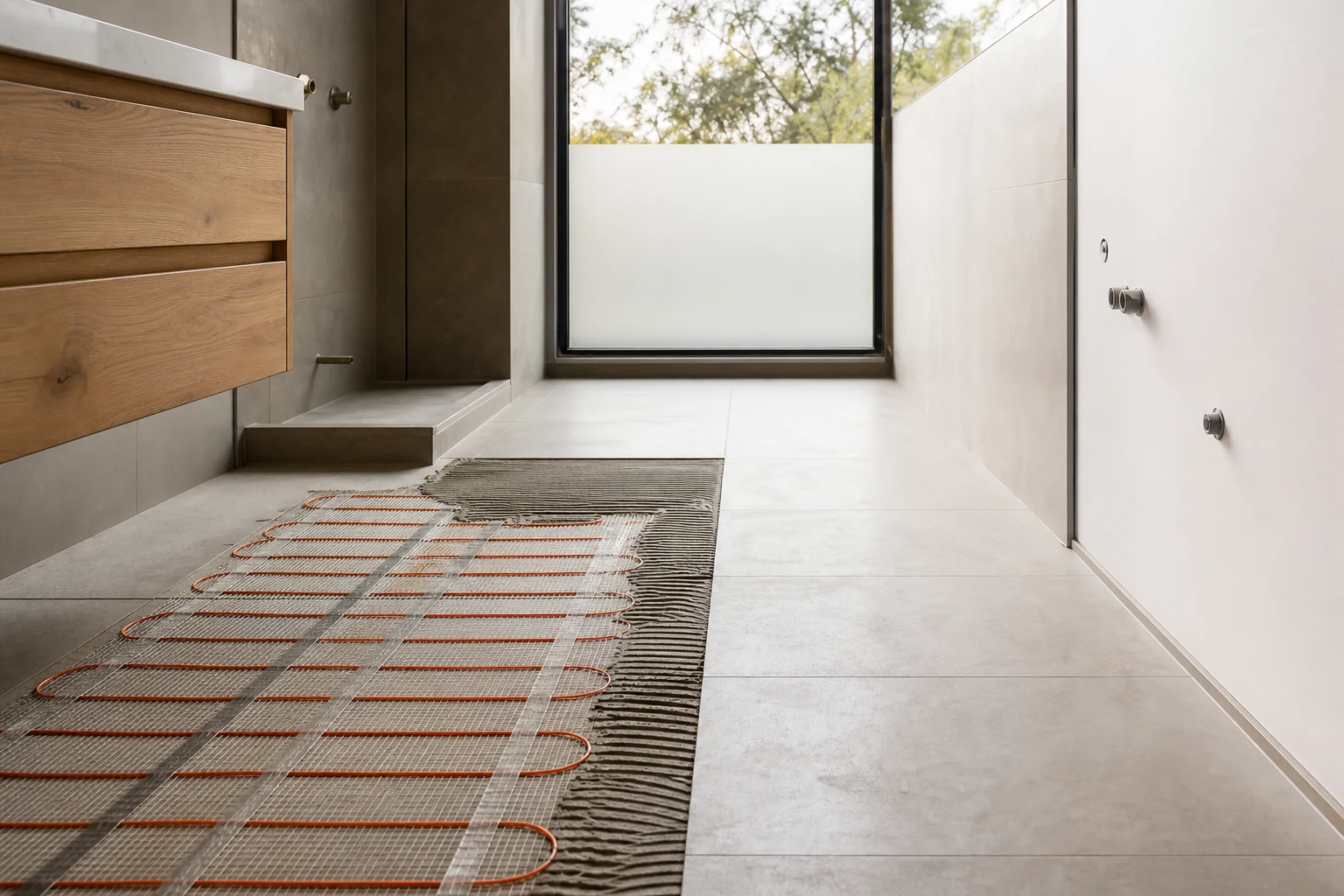
- Undertile electric mats or loose cable: Thin heating elements laid directly beneath the tile bed, above the waterproofing and screed. Fast heat-up, typically 20 to 40 minutes, and the most common choice for single bathroom renovations.
- In-screed electric cable: Thicker cable embedded within the screed layer. Slower to heat but holds warmth longer, suiting overnight off-peak charging strategies. Requires enough floor build-up to accommodate the cable within the screed.
- Hydronic (water-based) loops: Warm water circulated through pipes, usually fed by a heat pump or boiler. Economical to run at scale but expensive to establish for one room, so it generally only makes sense in full-home renovations where hydronic heating is being installed throughout.
For a typical Melbourne bathroom or ensuite renovation, undertile electric is the default recommendation: lowest complication, fast response and easy zoning with a dedicated thermostat.
Installed Costs Inside a Renovation
| System | Typical Installed Cost | Heat-Up Time | Best Suited To |
|---|---|---|---|
| Undertile electric mat | $900-$1,800 for a typical bathroom | 20-40 minutes | Single bathroom and ensuite renovations, timer-based use |
| In-screed electric cable | $1,100-$2,200 for a typical bathroom | 1-3 hours | Rooms with new screeds and owners using off-peak tariffs |
| Hydronic loop | $3,000-$6,000+ per room as part of a larger system | 1-4 hours | Full-home renovations installing hydronic heating throughout |
| Thermostat and electrical | $250-$600 within the above | n/a | Programmable or smart thermostat plus dedicated circuit work |
These figures assume the floor is already stripped as part of a renovation. Retrofitting heating into a finished bathroom means removing and replacing the tiles and waterproofing, which multiplies the cost several times over and is rarely sensible. The electrician must terminate the system and an in-floor sensor is standard; confirm both are included in the quoted figure rather than priced as extras.
Running Costs on Melbourne Tariffs
Running cost fears are usually overstated because owners imagine the system running all day. In practice, a programmed schedule covering the morning routine and an evening window is how most households use it.
- Typical bathroom load: A 3.5 square metre heated zone at around 150-160 watts per square metre draws roughly 0.5-0.6 kilowatts while heating.
- Typical usage pattern: Two hours in the morning and one to two hours at night in winter, with the thermostat cycling rather than drawing continuously.
- Indicative winter cost: Commonly in the range of $15-$40 per month for a single bathroom on general usage tariffs, less if the home has solar and the schedule leans on daylight generation, or if an in-screed system charges on off-peak rates.
Floor insulation boards installed beneath the heating element reduce downward heat loss into the slab and typically pay for themselves quickly on slab-on-ground homes, which describes a large share of Victorian housing built from the 1970s onward. On suspended timber floors, insulation beneath the element is even more important because the underfloor cavity is effectively outdoor air in winter.
How Heating Integrates With Waterproofing and Screeds
Sequencing matters, and this is where an experienced bathroom builder earns their fee. The heating element must sit in the correct layer of the floor build-up, and the waterproofing membrane, screed and tile bed all interact with it.
- Typical undertile sequence: Structural floor, screed to falls, waterproofing membrane, heating mat, tile adhesive bed, tiles. Some systems and membrane manufacturers vary this order, and the warranty depends on following the specified stack.
- In-screed sequence: The cable is fixed before the screed is poured, so the decision cannot be deferred. Falls to the floor waste must still be achieved above the cable.
- Testing: Resistance testing of the element before, during and after tiling is standard practice, because a nicked cable found after grouting means lifting tiles.
The floor waste zone and shower floor are normally excluded from heated area calculations, and clearances from the waste are maintained per the system specification. This is also why the heated area quoted is usually smaller than the room area: fixed joinery footprints, the shower and clearances all come out of the heated zone.
Electrical and Compliance Requirements in Victoria
Underfloor heating is fixed electrical equipment, so the work sits with a licensed electrician and finishes with a certificate of electrical safety. Expect the following in a compliant installation.
- Dedicated circuit protection: The system is protected by an RCD, and larger installations may warrant a dedicated circuit from the switchboard, which is worth confirming on older homes with crowded boards.
- In-floor temperature sensor: Installed in a conduit so it can be replaced without lifting tiles if it ever fails.
- Thermostat placement: Located outside splash zones per wet-area electrical rules, usually beside the light switch at the door.
- Documentation: Keep the element resistance readings, the circuit details and the certificate of electrical safety with your renovation handover pack, alongside the waterproofing certificate.
Older homes in suburbs with early wiring, common across the inner north and west, sometimes need switchboard upgrades before adding new fixed loads. That cost belongs in the renovation budget conversation early, not as a mid-build surprise.
When It Is Worth It and When to Skip It
Underfloor heating earns its cost in some situations and struggles to justify itself in others.
- Strong case: Main bathrooms and ensuites used every morning in winter, homes with solar generation, households planning to stay five or more years, and rooms with large-format porcelain or stone floors that feel notably cold underfoot.
- Moderate case: Family bathrooms used mainly by children in the evening, where a good heat lamp and towel rail combination covers most of the comfort need at lower cost.
- Weak case: Investment properties, powder rooms, rarely used guest bathrooms and projects where the budget is already stretched on essentials like waterproofing, ventilation and quality tiling.
A useful mental test: if adding heating means downgrading the waterproofing detail, the exhaust system or the tile quality, skip it. Comfort upgrades belong on top of a sound room, never instead of one. Heated towel rails, at $300-$900 installed, deliver a surprising share of the winter comfort for a fraction of the cost and remain the better first spend in tight budgets.
Specification Tips From the Tools
A few practical decisions separate installations that delight from those that disappoint.
- Heat the walkway, not the whole plan: Concentrate coverage where bare feet actually land: in front of the vanity, the bath and along the main path. This trims cost without trimming comfort.
- Choose a programmable or smart thermostat: Set-and-forget schedules are what make running costs modest. Manual switches get left on.
- Insulate beneath the element: Especially on slabs and suspended timber floors; the response time improves noticeably.
- Photograph the mat layout: Before tiling, photograph the element positions against fixed points. Future trades drilling a door stop into the floor will thank you.
- Register the warranty: Quality systems carry long element warranties, but registration and resistance test records are usually conditions.
Handled this way, underfloor heating is one of the most reliable satisfaction-per-dollar upgrades available in a Melbourne bathroom renovation, precisely because it targets the coldest months in a city that genuinely has them.
Take these ideas with you.
- Undertile electric systems typically cost $900-$1,800 installed during a renovation and heat up in under 40 minutes
- Winter running costs are commonly $15-$40 per month for a single bathroom when run on a programmed schedule
- Heating can only be added economically while the floor is stripped; retrofitting later means retiling the room
- Insulation boards under the element and a smart thermostat are the two upgrades that most improve performance
- If adding heating means cutting waterproofing, ventilation or tile quality, choose a heated towel rail instead
A few more answers
Questions about your next step.
What matters most in a small bathroom layout?
Clearances, door swing, shower placement and vanity depth matter more than decorative choices. Simplify the layout before adding premium finishes.
Which bathroom materials are easiest to maintain?
Low-porosity surfaces, practical grout, well-detailed shower screens and real ventilation reduce cleaning load and mould risk.
How long does a full bathroom renovation normally take?
Bathrooms are tightly sequenced, but waterproofing cure times, tiling and fixture lead times still make them multi-stage projects.
Put your ideas into a plan
Turn this cost guide into a real number
A useful quote names layout, services, finish level and exclusions. We measure in the house, then price the room you actually have.
Thinking about warm floors in your next bathroom? We plan the heating, screed and waterproofing as one sequence so the system is protected and certified properly. Learn about our bathroom renovations or call 1300 173 622.