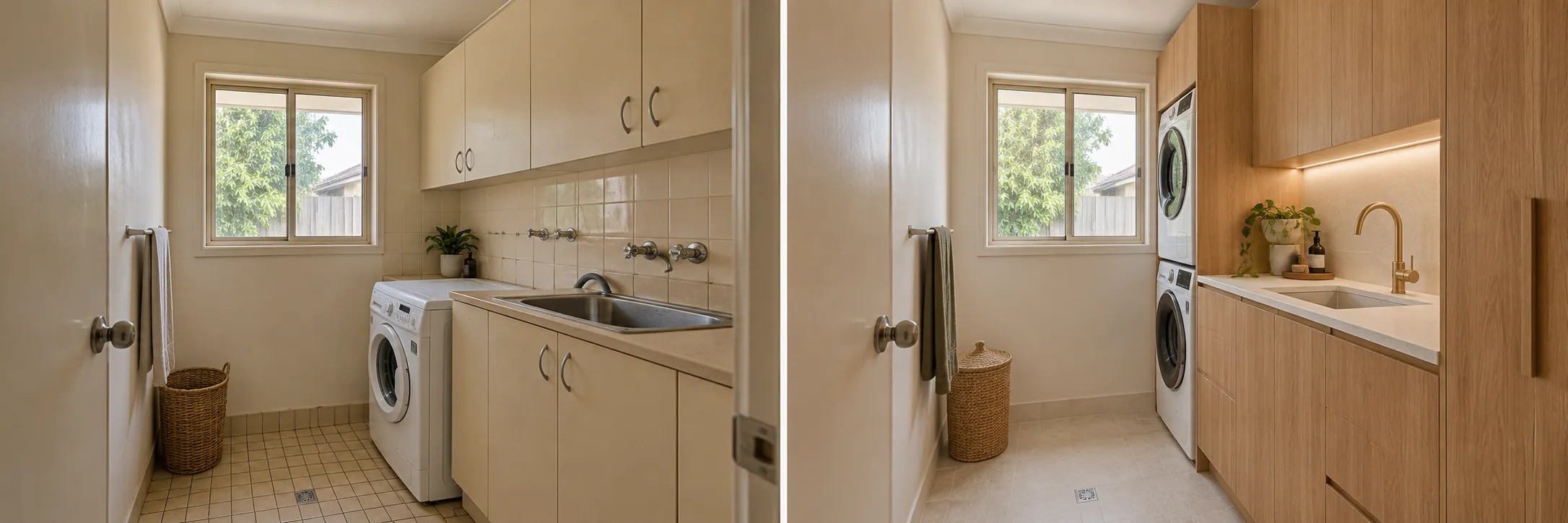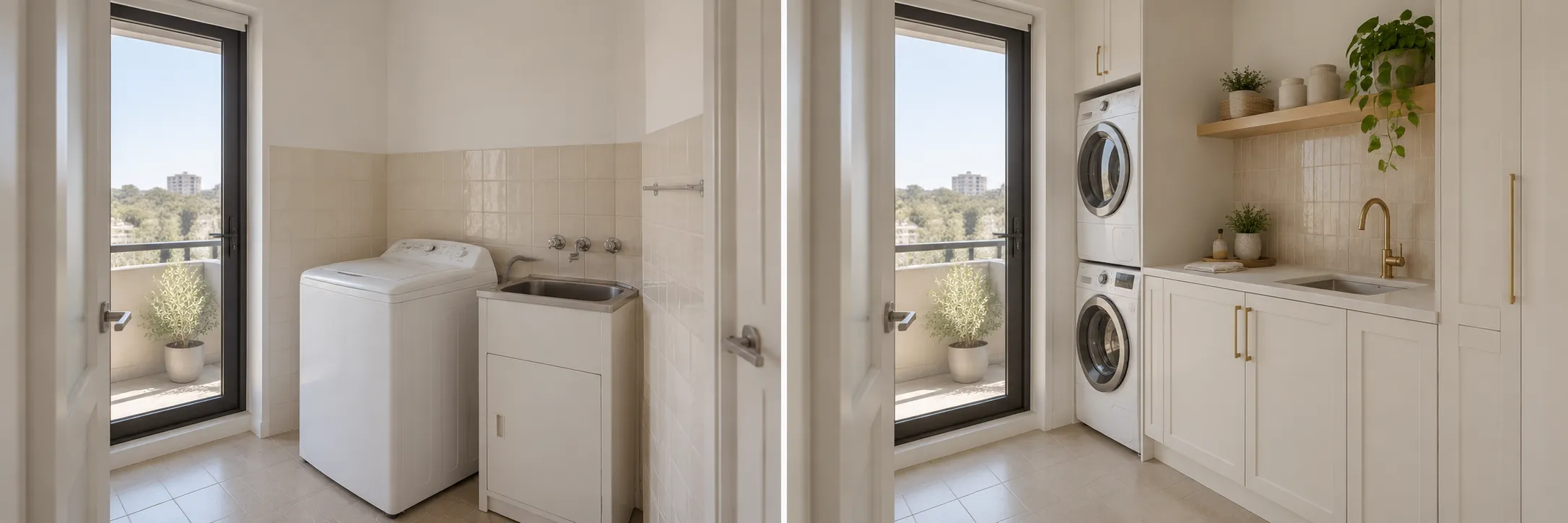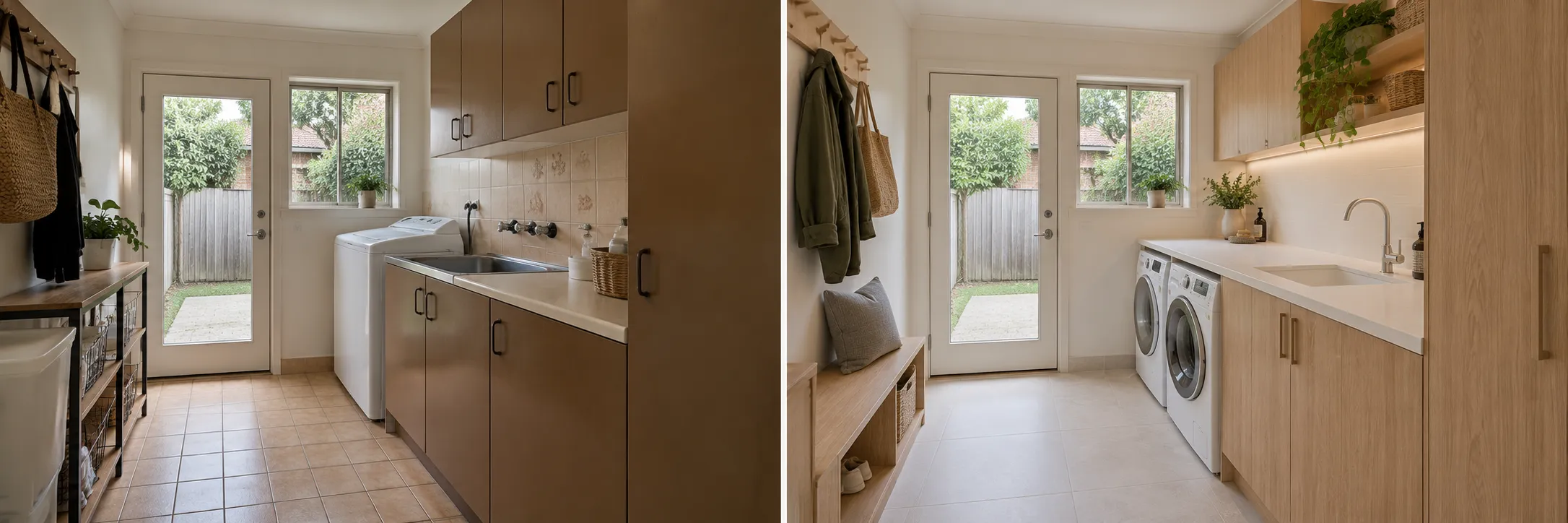
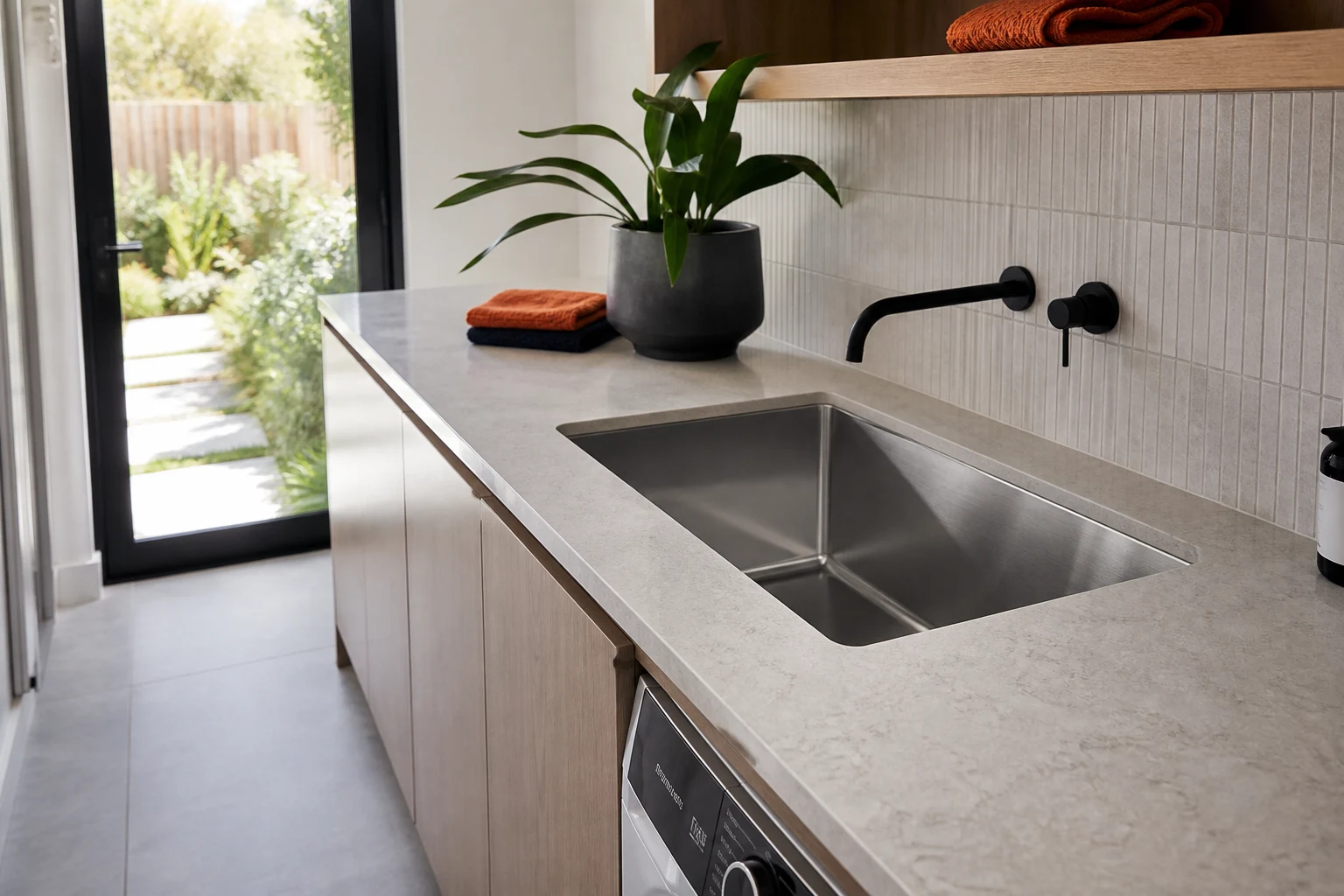
The laundry sink is the most used fixture in the room and the least considered line in most renovation quotes. It soaks uniforms, rinses paintbrushes, washes the dog, catches the mop bucket and takes everything the kitchen sink is too precious for. Choose well and it disappears into twenty years of quiet service; choose on price alone and you get a shallow, scratched basin that splashes the wall every time the tap runs.
This guide works through the decisions in order: how much capacity you actually need, what the material options really trade off, how mounting styles change both cost and cleanability, and the tapware and placement details that make a trough work as hard as the rest of the renovation.
In this guide
What the Trough Actually Does All Day
Before comparing bowls, list the jobs your household genuinely gives the laundry sink, because the list sets the size and material better than any showroom instinct.
- Soaking: Sports gear, school uniforms, stained linen. Needs depth and capacity, and ideally a plug-and-overflow arrangement that lets things sit safely.
- Dirty jobs: Paintbrushes, garden hands, muddy boots, pet washing. Needs a material that shrugs off abrasion and chemicals.
- Machine support: Hand-washing delicates, catching lint filters, pre-treating stains next to the washer.
- Utility drainage: Mop buckets and cleaning gear, which argues for a bowl deep enough to fit a bucket under the tap, a detail shallow designer bowls fail immediately.
Households that soak and pre-treat weekly need genuine capacity. Apartments where the trough mostly backs up the machines can go compact. Being honest about this before selection is what stops the twin regrets we hear most: the trough that was too shallow for a bucket, and the enormous tub that ate the entire bench for jobs that never happened.
Sizes and Capacities Compared
Trough capacity is quoted in litres, and the jump between categories is bigger than the numbers suggest once you stand in front of them.
| Capacity | Typical Bowl Size | Best For | Trade-Off |
|---|---|---|---|
| Compact (25-35L) | Around 400-500mm wide | European laundries, apartments, machine-support duties | Buckets and big soaks do not fit |
| Standard (35-45L) | Around 500-560mm wide | Most Melbourne family laundries; the sensible default | Occasional oversized soak jobs still feel tight |
| Large (45-70L) | 560-700mm wide, deeper bowls | Big households, pet washing, serious soaking and utility work | Consumes bench space and cabinet width |
| Double bowl | Two bowls, often 32L+ each | Simultaneous soak-and-rinse workflows | Rarely justified against the bench it sacrifices |
Depth deserves equal attention to volume: a bowl around 250-300mm deep controls splash from a high-flow tap and fits a bucket, while 180mm designer bowls do neither. If bench space allows only one upgrade, take depth over width.
Materials: Stainless, Ceramic and Composite
Laundry sinks live a harder life than kitchen sinks, so material behaviour under abrasion, chemicals and impact matters more than showroom finish.
- Stainless steel: The default for good reason. Tolerant of bleach-adjacent chemicals, boiling water and dropped tools, and light enough for simple mounting. Thicker gauges, roughly 0.9mm and up, resist denting and drumming; very thin budget bowls flex and scratch fast. Brushed finishes hide wear far better than polished.
- Ceramic and fireclay: Handsome, glassy and easy to wipe, with a period-appropriate look for Edwardian and Californian bungalow renovations. The trade-offs are chip risk from dropped hard objects, weight that demands proper cabinet support, and higher cost.
- Granite or quartz composite: Matte, contemporary and quiet, with strong stain and scratch resistance in quality brands. Pale composites can mark with some harsh chemicals, so check the care guide against your actual cleaning habits.
- Legacy concrete troughs: Still found in older Melbourne laundries and almost always worth replacing; they are porous, heavy and rough on fabrics.
For most renovations we specify brushed stainless in a standard or large capacity: it is the option nobody regrets. Ceramic and composite are legitimate upgrades where the laundry is on display, such as combined laundry-mudrooms off a kitchen.
Mounting: Inset, Undermount or Cabinet Unit
How the bowl meets the benchtop changes cost, cleanability and the joinery underneath it.
- Inset (top-mount): The bowl drops into a benchtop cut-out with a visible rim. Cheapest, works with laminate tops, easy to replace later. The rim collects grime over time, but a quality seal keeps it sound. The right call for most laminate-bench laundries.
- Undermount: The bowl fixes beneath the top for a rimless, wipe-straight-in surface. Needs a waterproof-edged top, in practice stone or solid surface, and adds fabrication cost. The right call when the laundry already carries a stone top.
- Flushline and integrated options: Premium territory where the sink and surface read as one; priced accordingly and rarely necessary in a utility room.
- All-in-one cabinet units: The classic 45-70L stainless tub on a compact steel or PVC cabinet. Cheap, fast and practical for garages and rentals, but they interrupt a joinery run and read as budget in a renovated room.
One structural note: large ceramic bowls and deep stainless tubs full of water are heavy. Cabinet carcasses need appropriate support rails, and undermount fixings must be rated for the load, details a good joiner handles by default and a cheap quote may not.
Tapware and the Machine Bypass
Trough tapware has its own small checklist, and getting it right costs little more than getting it wrong.
- Reach and height: The spout should land near the bowl centre, with clearance to fit a bucket beneath. Gooseneck mixers earn their place here more than anywhere else in the house.
- Pull-out sprays: Genuinely useful in a laundry for rinsing the bowl, soaking gear and washing pets. Choose a quality brand, since laundry pull-outs work hard.
- Lever handling: A single-lever mixer operated with a forearm suits dirty-hands jobs better than twin taps.
- Machine connections: Washing machine taps are separate items, usually concealed beside or behind the machine. Confirm your plumber allows for both, plus a bypass arrangement where the machine drains via the trough in some configurations.
- WELS ratings: Laundry taps run frequently; a decent efficiency rating quietly saves water without affecting utility.
As with all plumbing in Victoria, installation belongs to a licensed plumber, with a compliance certificate for work above the threshold. Owner-supplied tapware is fine, but have the plumber confirm the model suits the water pressure and the trough before it is bought.
Placement and Workflow in the Room
Where the trough sits shapes how the laundry works. The strongest position is between the washing machine and the main bench run: pre-treat at the trough, transfer wet items directly to the machine, fold on the bench beyond. That left-to-right or right-to-left flow, matched to which side the machine door hinges, removes the drips-across-the-floor problem entirely.
- Next to the machine: The non-negotiable adjacency. A trough across the room from the washer guarantees a wet floor path.
- Under a window: Pleasant where the floor plan allows, and common in older Melbourne laundries; just confirm tapware height clears the sill.
- Splashback: Tiles or an impervious sheet behind the trough is a wet-area requirement zone and a practical necessity; grout or panel joints should be sealed against detergent splash.
- Bench relationship: Keep at least 400-600mm of bench beside the bowl for wet-item staging. A trough hard against a wall on both sides works, but it works annoyingly.
In European laundries the same logic compresses: a compact bowl beside or between machines with a slim staging shelf beats no sink at all, provided the width truly allows it.
What to Spend and What You Get
Trough and tapware budgets span a wide range, but the middle of the market is where value concentrates. A quality brushed stainless 45L bowl sits in the low hundreds; composite and ceramic step up from there; and robust laundry mixers with pull-out sprays occupy the $150-$450 band, with premium finishes above. All-in cabinet units land cheapest of all but suit utility spaces rather than renovated rooms.
Two rules keep the spend honest. First, match the trough to the benchtop decision, since undermounting only pays where a stone top already exists. Second, put the last hundred dollars into depth, gauge and tapware quality rather than finish colour, because the laundry sink is bought once and used daily for decades. Specified with the same care as the kitchen sink, at a fraction of the price, it becomes one of the quiet successes of the whole renovation.
Take these ideas with you.
- Size the trough from the jobs it actually does, with 35-45L standard bowls suiting most Melbourne family laundries
- Bowl depth matters as much as capacity, since a 250-300mm deep bowl controls splash and fits a bucket under the tap
- Brushed stainless in a decent gauge is the no-regrets material, with ceramic and composite as display-laundry upgrades
- Inset mounting suits laminate tops and undermount only pays where a stone benchtop already exists
- Place the trough beside the washing machine with 400-600mm of staging bench, and let a licensed plumber certify the connections
A few more answers
Questions about your next step.
How much should I budget for a kitchen renovation in Melbourne?
Budget depends on layout changes, cabinetry level, benchtop choice, appliance scope and trade complexity. Fixed-layout refreshes sit much lower than structural redesigns with new services.
What kitchen upgrades usually add the most practical value?
Better drawer storage, smarter appliance placement, durable benchtops, layered task lighting and a well-sized rangehood tend to outperform cosmetic-only upgrades.
How long does a kitchen renovation usually take?
Most kitchens run over several weeks. Cabinetry manufacturing, stone templating and trade sequencing usually matter more than the demolition day.
Put your ideas into a plan
Turn this cost guide into a real number
A useful quote names layout, services, finish level and exclusions. We measure in the house, then price the room you actually have.
Renovating your laundry and want every fixture chosen for the next twenty years, not just handover day? That is how we specify. Explore our laundry renovation service.