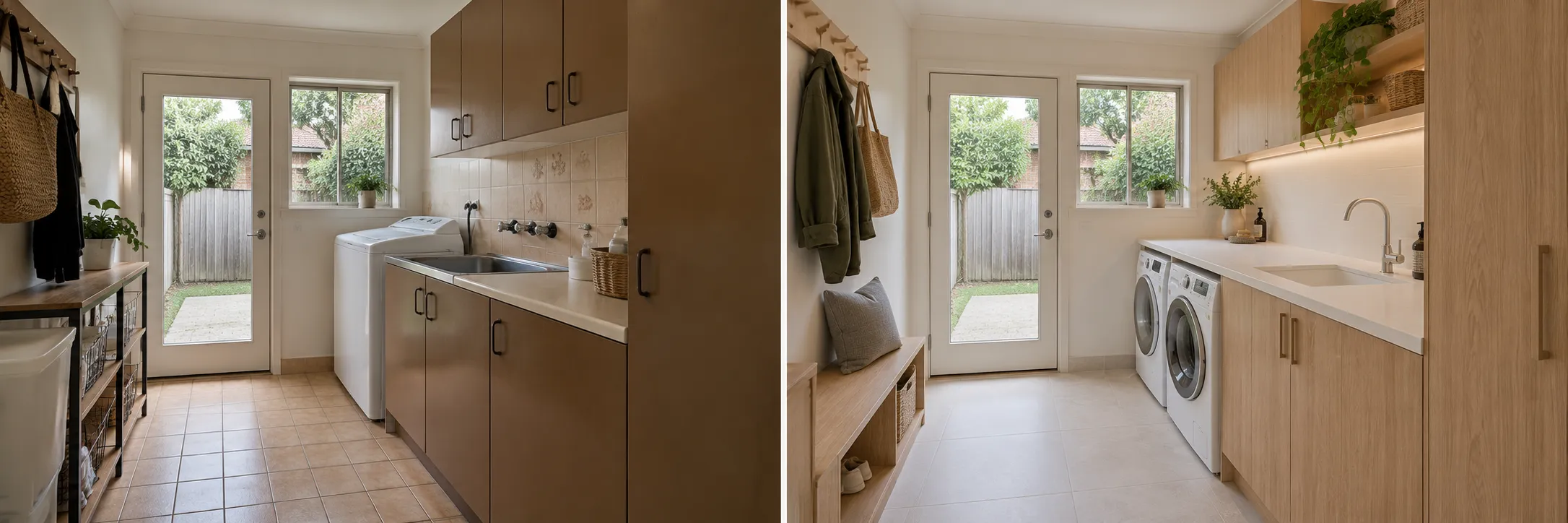
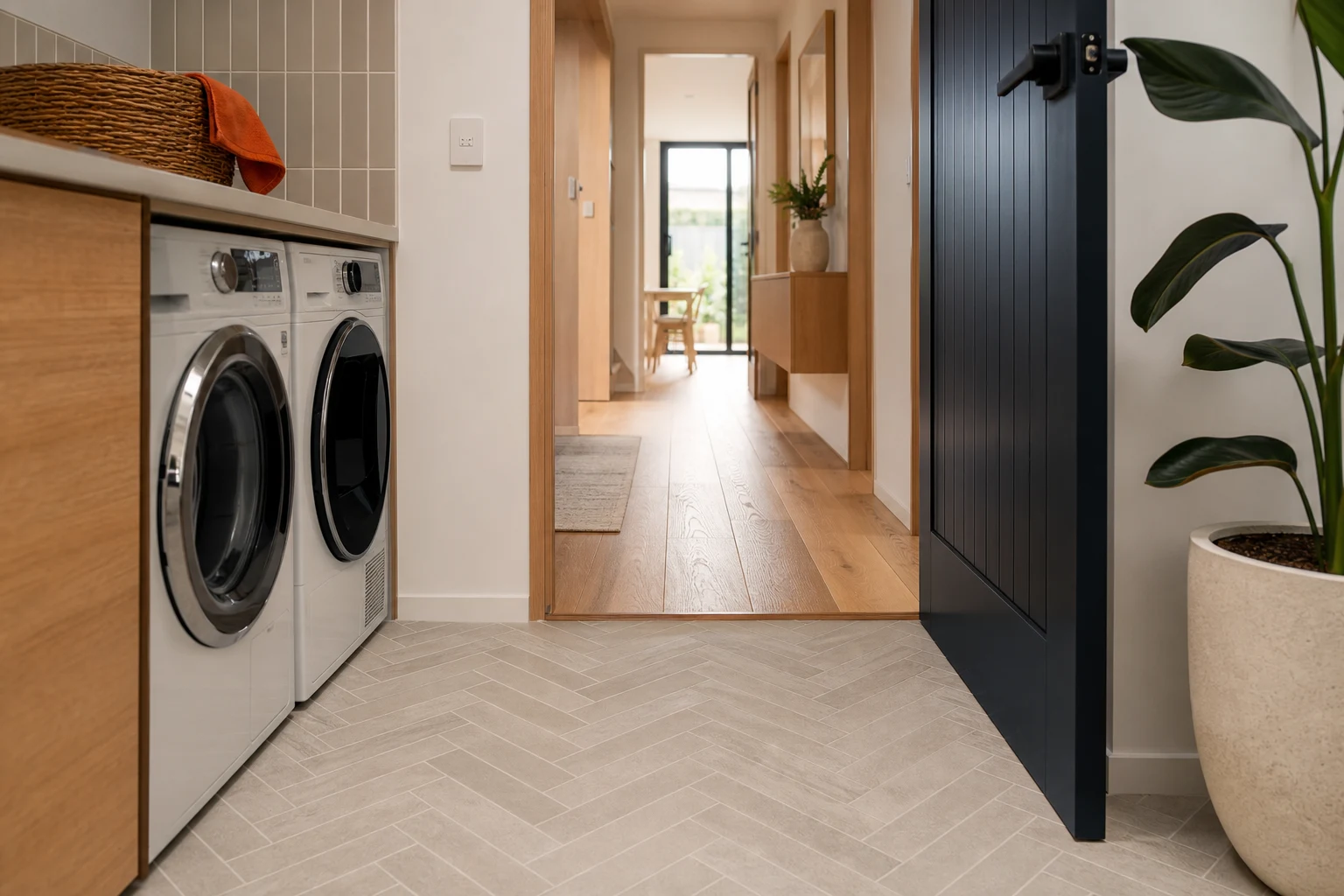
The laundry is one of the hardest-working floors in a Melbourne home. It cops standing water from machine overflows and dripping washing, detergent spills, foot traffic in wet shoes during winter, and the constant vibration of a washer on spin cycle. Choosing flooring for this room on looks alone is how homeowners end up with swollen boards, lifting edges or slippery surfaces within a few years.
Three options dominate laundry renovations across Melbourne: ceramic or porcelain tiles, hybrid planks, and sheet vinyl. Each can be the right answer depending on your subfloor, budget, drainage setup and how the laundry connects to the rest of the house. This guide compares them the way a builder does, including the waterproofing and compliance details that matter more than the showroom sample.
In this guide
Why Laundry Flooring Is a Different Decision to Living Areas
A laundry floor deals with conditions that living-area flooring never sees. Before comparing products, it helps to understand what the floor actually has to survive.
- Standing water risk: Hose failures, blocked filters and overflowing troughs can leave water pooling for hours before anyone notices, especially in a closed-door laundry.
- Chemical exposure: Bleach, detergent, stain removers and fabric softener all end up on the floor eventually, and some finishes discolour or degrade under repeated contact.
- Appliance vibration and point loads: A loaded washing machine on spin cycle transfers real force into the floor. Soft or poorly bonded flooring telegraphs this as movement and noise.
- Wet-area compliance: Under the National Construction Code as applied in Victoria, laundries are wet areas with specific water-resistance requirements for floor and wall junctions. Your flooring choice interacts directly with the waterproofing detail underneath it.
In older Melbourne homes, particularly weatherboard houses in suburbs like Preston, Coburg and Ringwood, the laundry often sits on a timber subfloor at the rear of the house. Timber subfloors move seasonally and are far less forgiving of rigid finishes installed without proper preparation. Slab-on-ground homes across the newer growth corridors present the opposite problem: the slab is stable but often out of level, and every flooring type needs a flat substrate to perform.
Option 1: Ceramic and Porcelain Tiles
Tiles remain the default recommendation for most full laundry renovations, and for good reason. A correctly installed tiled floor over a compliant waterproofing membrane is effectively immune to the failure modes that kill other flooring types.
- Water performance: Porcelain absorbs almost no moisture. Combined with a membrane and a floor waste, a tiled laundry can handle a full machine overflow without permanent damage.
- Durability: A quality porcelain tile will outlast the cabinetry, the machines and probably the next two repaints of the house. There is no wear layer to exhaust.
- Falls to a floor waste: Tiles are the only option here that lets your builder screed genuine falls to a floor waste, which is the single best insurance policy a laundry can have.
- Design range: Large-format porcelain, matt stone looks and timber-look planks in tile form all work well, and slip-rated finishes are widely available.
The trade-offs are real, though. Tiles are the most expensive option once you include screeding, waterproofing, laying and grouting, and the labour component dominates the cost in a small room. They are cold underfoot in a Melbourne winter unless you add heating, hard on dropped items, and unforgiving if the substrate preparation is rushed. Grout also needs occasional maintenance, although epoxy grout largely solves staining in a laundry context.
Typically, a tiled laundry floor in Melbourne lands somewhere between $1,500 and $3,500 for supply and install in a standard-sized room, depending on tile choice, screed requirements and whether a new floor waste is being plumbed in.
Option 2: Hybrid Planks
Hybrid flooring, a rigid-core plank that combines the stability of laminate construction with a fully waterproof polymer core, has become extremely popular in Melbourne renovations because it runs seamlessly from living areas into adjoining rooms. Many homeowners renovating a laundry as part of a wider project want one continuous floor, and hybrid makes that possible.
- Waterproof board, not waterproof floor: This is the critical distinction. The plank itself will not swell, but water can still migrate through joints and perimeter gaps to the subfloor beneath. A flooded laundry with hybrid over particleboard can still mean structural repairs.
- Comfort and warmth: Hybrid is noticeably warmer and softer underfoot than tile, which matters in an uninsulated rear laundry in July.
- Speed and cost: Installation is fast, requires no wet trades, and commonly costs $65 to $110 per square metre installed, making it the mid-priced option.
- Continuity: No trims or steps between the laundry and hallway if the same product runs throughout.
Where hybrid falls down is under appliances and around water sources. Some manufacturers limit or void warranties in laundries, or require silicone-sealed perimeters and appliance trays. Heavy front-loaders can also dent or mark some products over time. If you choose hybrid, insist on a written confirmation that the specific product is warranted for laundry use, fit a metal or plastic overflow tray under the washer, and make sure the waterproofing behind and below still complies. Hybrid is a floating floor, so it also cannot be laid to falls, which means no functional floor waste drainage.
Option 3: Sheet Vinyl
Sheet vinyl is the quiet achiever of laundry flooring, and it deserves more respect than it gets. Modern commercial-grade vinyl bears little resemblance to the dated product many homeowners picture from rental properties.
- Seamless water resistance: Because it comes in wide rolls, a small laundry can often be covered in a single piece with no joints at all. Welded seams and coved edges, where the vinyl turns up the wall like a skirting, create a near-bulletproof water barrier used in hospitals and commercial kitchens for exactly this reason.
- Soft, quiet and warm: Vinyl absorbs machine vibration better than any hard surface and is the most comfortable option to stand on while folding washing.
- Low cost: Commonly the cheapest of the three options installed, particularly in small rooms where tile labour costs bite hardest.
- Slip resistance: Slip-rated safety vinyl is readily available and performs well when wet.
The compromises are aesthetic and long-term. Even good timber-look and stone-look vinyl reads as vinyl up close, which can matter in an open mudroom-laundry visible from living areas. It can be cut or gouged by dragged appliances, it relies heavily on subfloor preparation because every imperfection telegraphs through, and its lifespan of roughly 10 to 20 years is shorter than tile. Resale perception in premium suburbs is also a consideration: a beautifully tiled laundry presents better in Kew than a vinyl one, however practical the vinyl may be.
Side-by-Side Comparison
| Factor | Tiles | Hybrid Planks | Sheet Vinyl |
|---|---|---|---|
| Installed cost (typical laundry) | $1,500-$3,500 | $800-$1,800 | $600-$1,400 |
| Flood tolerance | Excellent with membrane and floor waste | Board survives, subfloor may not | Very good if seams are welded and edges coved |
| Can be laid to falls with floor waste | Yes | No | Yes, over a screeded substrate |
| Comfort and warmth underfoot | Cold and hard | Good | Best of the three |
| Expected lifespan | 30+ years | 10-20 years | 10-20 years |
| Best suited to | Full renovations, floor wastes, resale value | Whole-floor continuity with living areas | Budget renovations, rentals, timber subfloors |
No single column wins every row, which is exactly why the right answer depends on the project. The table is a starting point; the deciding factors are usually drainage, subfloor type and how the laundry connects to adjacent rooms.
The Waterproofing Detail Underneath Matters More Than the Floor
Whichever surface you choose, the layer beneath it determines whether a minor appliance failure becomes a claim on your insurance. In Victoria, wet-area waterproofing must be carried out to the relevant Australian Standard, and on renovations involving building work your builder is responsible for getting this detail right.
- Floor wastes: Not mandatory in every laundry, but strongly recommended in any laundry above ground level and cheap insurance everywhere else. Retrofitting one costs far less during a renovation than after a flood.
- Membrane extent: Good practice extends the membrane across the full floor and up walls behind the trough and machine positions, not just the minimum splash zones.
- Hob and junction details: Floor-to-wall junctions are where most laundry leaks actually start. These need proper bond-breakers and membrane detailing regardless of the finished floor.
- Machine taps and hoses: Braided hoses and accessible isolation taps reduce the most common flood cause, a failed rubber hose behind a machine that has not been touched in fifteen years.
A common renovation shortcut is laying hybrid or vinyl directly over an old floor with no membrane review. If the existing laundry has a history of dampness, musty smells or soft spots near the trough, insist on opening the floor up before the new finish goes down.
How to Choose for Your Situation
After enough laundry renovations across Melbourne, clear patterns emerge in which floor suits which project.
- Choose tiles if: You are doing a full strip-out renovation, you want a floor waste, the laundry doubles as a mudroom or dog-wash zone, or long-term durability and resale presentation are priorities.
- Choose hybrid if: The laundry is being renovated as part of a larger project with continuous flooring, the water risk is managed with trays and quality hoses, and the product is explicitly warranted for laundry use.
- Choose sheet vinyl if: Budget is tight, the subfloor is timber and movement is a concern, the property is an investment, or you want maximum practical water resistance without the cost of tiling.
One final note on mixing: it is completely legitimate to tile the laundry while running hybrid through the rest of the house. A well-detailed transition at the doorway costs little and gives the wet room the floor it deserves. Trying to force one product to do every job in the house is how compromises happen in the room that can least afford them.
Take these ideas with you.
- Tiles over a compliant membrane with a floor waste remain the most flood-proof laundry floor available
- Hybrid planks are waterproof as boards, but water can still reach and damage the subfloor beneath them
- Modern sheet vinyl with welded seams is a seriously underrated, budget-friendly wet-area performer
- The waterproofing detail under the floor matters more than the finish you walk on
- Mixing flooring types, such as a tiled laundry off a hybrid hallway, is often the smartest compromise
A few more answers
Questions about your next step.
How much should I budget for a kitchen renovation in Melbourne?
Budget depends on layout changes, cabinetry level, benchtop choice, appliance scope and trade complexity. Fixed-layout refreshes sit much lower than structural redesigns with new services.
What kitchen upgrades usually add the most practical value?
Better drawer storage, smarter appliance placement, durable benchtops, layered task lighting and a well-sized rangehood tend to outperform cosmetic-only upgrades.
How long does a kitchen renovation usually take?
Most kitchens run over several weeks. Cabinetry manufacturing, stone templating and trade sequencing usually matter more than the demolition day.
Put your ideas into a plan
Turn this cost guide into a real number
A useful quote names layout, services, finish level and exclusions. We measure in the house, then price the room you actually have.
Unsure which floor suits your laundry, subfloor and budget? We renovate laundries across Melbourne and can recommend the right build-up for your specific room, not a generic answer. Explore our laundry renovation service.