The sink and tap are the hardest-working items in any kitchen, used dozens of times a day for decades, yet they are routinely chosen in the last week before joinery drawings are due, from whatever the plumbing supplier had on display. The result is predictable: bowls too small for the roasting pan, finishes that spot and wear, and taps that fight the window behind the sink.
This guide covers the decisions that matter: bowl configuration and size, mounting styles and what they mean for your benchtop, tapware types and finishes that survive real use, and the coordination details that must be settled before the stone is templated. Small products, big consequences.
In this guide
- Bowl Configuration: One Big Bowl Usually Wins
- Mounting Styles and What They Demand From the Benchtop
- Sink Materials: Stainless Is Still the Benchmark
- Tapware Types: Function First, Finish Second
- Finishes That Survive: An Honest Ranking
- Placement and Plumbing Coordination
- Budget Guidance for Melbourne Projects
Bowl Configuration: One Big Bowl Usually Wins
The double-bowl sink was the default for generations because one side washed and one side rinsed. Dishwashers changed the job description, and the market has followed.
- Single large bowl: The modern default. A bowl around 700-800mm wide swallows oven trays, stockpots and chopping boards flat. If the dishwasher handles daily dishes, the sink exists for the big items.
- One-and-three-quarter bowl: A large main bowl with a small secondary for rinsing or waste-disposal duty. A sensible compromise for households that genuinely use both.
- Double equal bowls: Still right for households that hand-wash regularly, but each bowl ends up too small for trays, which is the most common post-renovation sink complaint we hear.
- Butler's pantry pairing: Where a second sink exists in a butler's pantry, the main kitchen sink can go single and generous with no downside.
Depth matters too: 180-220mm is the practical range. Deeper reduces splashing and hides dishes; too deep punishes tall users at a standard 900mm bench height.
Mounting Styles and What They Demand From the Benchtop
| Mounting Style | Works With | Typical Cost Impact | Practical Notes |
|---|---|---|---|
| Top-mount / drop-in | Any benchtop including laminate | Lowest | Rim sits proud; crumbs catch at the edge; easiest replacement later |
| Undermount | Stone, porcelain, solid surface | Moderate, added fabrication | Clean wipe-straight-in benchtop; needs quality cut-out polishing and support |
| Flush-mount | Stone and porcelain, precision fabrication | Higher | Sink rim sits level with the surface; premium look, unforgiving tolerances |
| Integrated / apron front | Specific joinery design required | Highest | Farmhouse fronts need purpose-built cabinetry decided before manufacture |
The coordination rule underneath the table: the exact sink model must be with the benchtop fabricator before templating. Undermount cut-outs are made to the specific bowl, and a late substitution means a remake, not an adjustment.
Sink Materials: Stainless Is Still the Benchmark
Fashion cycles through sink materials, but the performance rankings barely move.
- Stainless steel: The benchmark for durability, heat tolerance and hygiene. Thicker gauges and sound-deadening pads separate quality units from tinny budget ones. Brushed finishes hide scratches best.
- Granite composite: Matte stone-look bowls in black, white and grey. Very durable and quiet, though pale versions can stain with tea and coffee if neglected, and dark versions show mineral deposits in Melbourne water unless wiped down.
- Fireclay and ceramic: The farmhouse look. Beautiful, heavy, and hard on dropped glassware; chips are possible and repairs are visible.
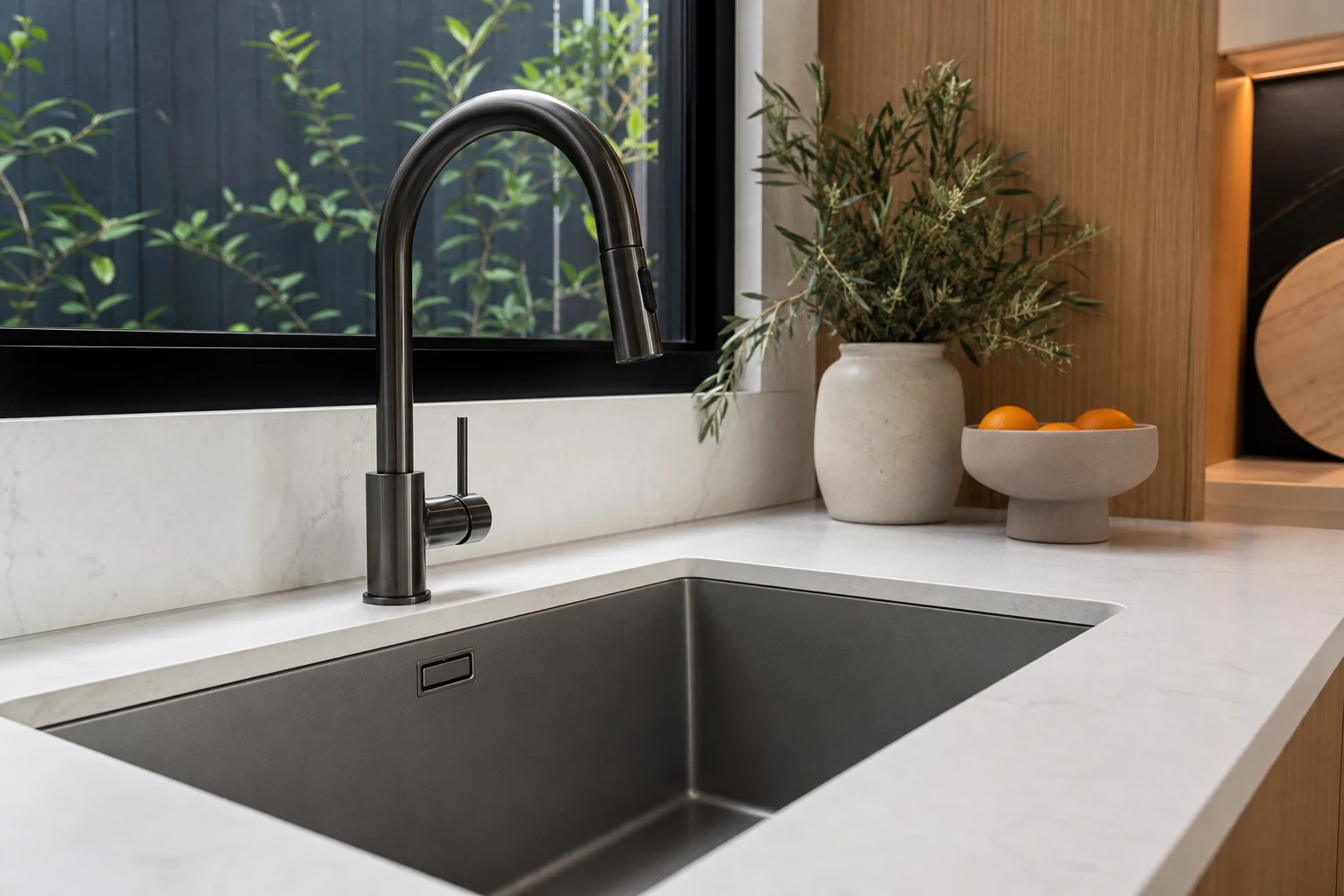
- Coloured PVD stainless: Gunmetal, brass and copper-toned stainless bowls match tapware trends. Quality coatings wear well, but treat them as finishes, not armour.
For rental properties and hard-working family kitchens we still specify brushed stainless most often. It is the finish that looks acceptable after a decade of honest neglect.
Tapware Types: Function First, Finish Second
Tapware is chosen with the eyes and lived with by the hands. The mechanism matters more than the catalogue photo.
- Pull-out spray mixers: The workhorse of modern kitchens. Rinsing the sink, filling pots beside the bowl and washing trays all become easier. Quality of the hose and weight mechanism is where cheap units fail.
- Gooseneck mixers: High clearance for stockpots and a strong visual anchor. Check the spout reach lands over the bowl centre, not the benchtop.
- Gantry / articulated taps: Statement pieces for serious cooks; premium price, generous clearances.
- Filtered and boiling-water taps: Increasingly common additions. They need under-bench space for the tank and filter plus a power point, planned into the sink cabinet before joinery manufacture.
Check WELS ratings when comparing: kitchen mixers commonly sit in the 4-6 star range, and a decent rating saves water without any noticeable difference at the dish end.
Finishes That Survive: An Honest Ranking
Finish durability, not colour, should drive the tapware decision, because the tap is touched with wet, greasy, acidic hands every day.
- Chrome: Still the durability king and the easiest to clean. Its only crime is being common.
- Brushed nickel and brushed stainless: Excellent wear, hides water spotting far better than polished finishes. The safe premium choice.
- Quality PVD finishes: Brushed brass, gunmetal and matte gold applied by PVD are genuinely hard-wearing. Cheap electroplated versions of the same colours are not; the price difference is the coating.
- Matte black: Looks superb, shows mineral spotting quickest, and cheap versions chip at the aerator and handle edges. Buy quality or choose differently.
A practical rule: match finish families across the kitchen, tap, sink, handles and appliances in compatible tones, but do not chase an exact match across different manufacturers. Near-match reads intentional; slightly-off reads like an error.
Placement and Plumbing Coordination
Several small decisions around the sink zone have outsized daily impact and must be locked before rough-in.
- Tap position versus window: A tall gooseneck in front of a sash window or behind-bench window winder is a classic clash. Check spout height against the sill and any opening hardware.
- Reach geometry: The spout should land roughly over the bowl centre. Corner-sink layouts and offset drainers change the answer.
- Under-sink real estate: Bin pull-outs, filter tanks, and boiling-water units all compete for the same cabinet. Draw the cabinet interior, not just the door front.
- Water hammer and isolation: New mixers on old Melbourne pipework can knock; isolation valves and arrestors during the renovation cost little and save callbacks.
- Dishwasher adjacency: Keep the dishwasher within a step of the sink and the cutlery drawer, the unload triangle matters as much as the cooking one.
Budget Guidance for Melbourne Projects
Realistic allowances for a mid-range Melbourne kitchen: $400-$1,200 for a quality sink, $300-$900 for a durable mixer, more if a filtered or boiling-water system joins the list. Premium European tapware and specialist finishes can multiply those numbers without changing daily function much.
Where the budget is tight, our advice is consistent: buy the biggest quality bowl the joinery allows, a mid-range pull-out mixer in a PVD or brushed finish, and put the savings toward the benchtop. Nobody ever regretted a generous sink.
Take these ideas with you.
- A single large bowl suits most dishwasher-equipped households better than a traditional double
- Undermount and flush-mount sinks need the exact model confirmed before benchtop templating
- Brushed stainless and quality PVD finishes outlast trendy cheap coatings by years
- Pull-out spray mixers are the practical default; check spout reach and window clearances
- Plan under-sink space for bins, filters and boiling-water tanks before joinery manufacture
A few more answers
Questions about your next step.
How much should I budget for a kitchen renovation in Melbourne?
Budget depends on layout changes, cabinetry level, benchtop choice, appliance scope and trade complexity. Fixed-layout refreshes sit much lower than structural redesigns with new services.
What kitchen upgrades usually add the most practical value?
Better drawer storage, smarter appliance placement, durable benchtops, layered task lighting and a well-sized rangehood tend to outperform cosmetic-only upgrades.
How long does a kitchen renovation usually take?
Most kitchens run over several weeks. Cabinetry manufacturing, stone templating and trade sequencing usually matter more than the demolition day.
Put your ideas into a plan
Turn this cost guide into a real number
A useful quote names layout, services, finish level and exclusions. We measure in the house, then price the room you actually have.
We coordinate sinks, tapware, joinery and stone as one package so nothing clashes on install day. Learn about our kitchen renovations or call 1300 173 622 to get your selections sequenced properly.