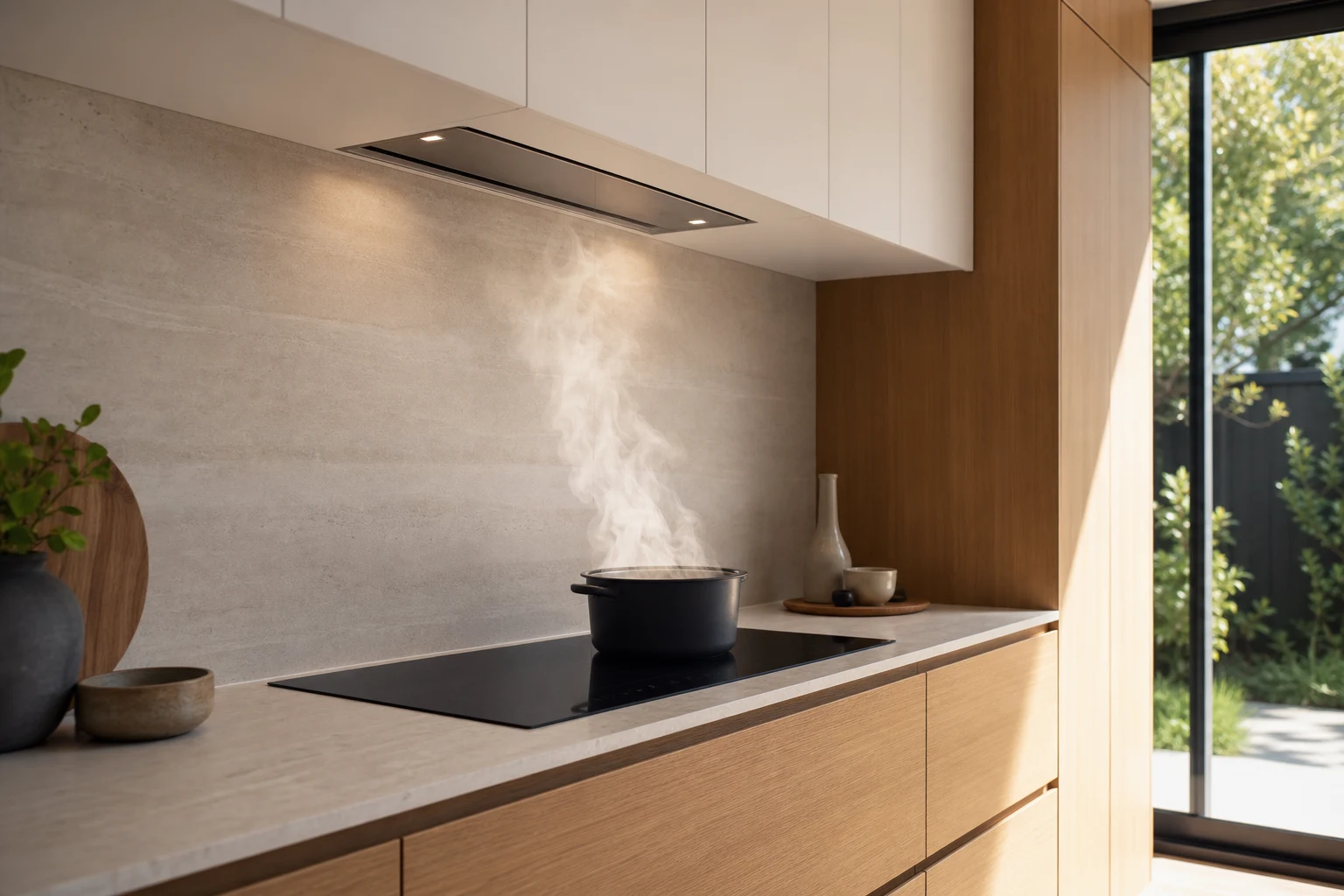
The rangehood is the appliance Melbourne homeowners spend the least time choosing and the most time regretting. A hood that looks right on the showroom floor can still fail at its actual job: capturing steam, grease and cooking odours before they spread through an open-plan living zone. Once cooking smells settle into soft furnishings and grease films onto overhead cabinetry, no amount of styling fixes the problem.
This guide explains how a renovation builder actually assesses rangehood selection: capture area over brand names, ducting path over box specifications, and real-world noise over laboratory ratings. Getting these three things right during the design stage costs very little. Fixing them after handover is expensive and sometimes impossible without opening ceilings.
In this guide
- Ducted vs Recirculating: The Decision That Matters Most
- Rangehood Types Compared
- Capture Area Beats Extraction Rate
- Ducting Runs: Where Good Hoods Go to Die
- Noise: The Specification Everyone Ignores Until Dinner Parties
- Coordinating the Hood With Joinery and Services
- How Much to Allow in a Melbourne Kitchen Budget
Ducted vs Recirculating: The Decision That Matters Most
Every other rangehood decision sits downstream of this one. A ducted hood pushes cooking air outside the home through a duct run. A recirculating hood filters air through carbon filters and returns it to the room.
- Ducted extraction: Removes steam, moisture and odour from the house entirely. This is the standard we recommend for almost every Melbourne kitchen renovation, especially with gas cooking or open-plan layouts.
- Recirculating extraction: Captures some grease and reduces some odour, but returns all moisture and heat to the room. Carbon filters also need replacement every few months to keep working at all.
- Convertible models: Many hoods can run either way, which is useful when the ducting decision is still open during early design.
Recirculating hoods are sometimes unavoidable in apartments where the owners corporation will not approve external penetrations. In a detached or semi-detached Melbourne home undergoing a full kitchen renovation, there is almost always a viable duct path, and finding it should be part of the design conversation rather than an afterthought.
Rangehood Types Compared
Hood format affects capture performance, joinery design and budget in different ways. This comparison reflects what we typically see across Melbourne renovation projects.
| Hood Type | Typical Price Range | Capture Performance | Best Suited To |
|---|---|---|---|
| Slide-out / retractable | $200-$700 | Modest, small capture area | Budget refreshes where the hood sits under an overhead cabinet |
| Undermount / integrated | $500-$2,500 | Good when sized correctly | Kitchens where joinery lines matter and the hood should disappear |
| Canopy / chimney | $600-$3,000+ | Strong, large capture hood | Wall-run cooktops in family kitchens with regular heavy cooking |
| Island canopy | $1,500-$5,000+ | Good, but crosswinds reduce capture | Island cooktops where ceiling ducting is achievable |
| Downdraft / benchtop | $2,000-$7,000+ | Variable, works against rising steam | Island layouts where an overhead hood is unacceptable visually |
The pattern worth noticing: the formats that look the most minimal usually work the hardest to achieve acceptable capture, and they lean heavily on correct ducting to compensate.
Capture Area Beats Extraction Rate
Marketing focuses on extraction rates measured in cubic metres per hour, but a big number on the box does not guarantee a clean kitchen. Capture area, the physical size and shape of the hood relative to the cooktop, matters more in daily use.
- Match or exceed the cooktop width: A 600mm hood over a 900mm cooktop leaves the outer burners venting straight past the filters. Going one size up on the hood is one of the cheapest performance upgrades available.
- Depth matters on islands: Steam plumes drift, and an island hood with a shallow canopy misses anything a cross-breeze pushes sideways.
- Mounting height is a compromise: Most manufacturers specify roughly 600mm to 750mm above the cooktop. Lower improves capture, higher improves sightlines. Fix this dimension on the joinery drawings, not on site.
As a working rule for Melbourne family kitchens, an extraction rate in the range of 500 to 900 cubic metres per hour is typically adequate, provided the ducting run does not strangle it, which brings us to the part of the system nobody sees.
Ducting Runs: Where Good Hoods Go to Die
A premium hood connected to a long, narrow, kinked duct performs like a budget hood. Duct design is a builder and trades conversation, and it should happen before joinery drawings are approved.
- Duct diameter: Keep the full manufacturer-specified diameter, commonly 150mm, for the entire run. Reducing to 125mm to squeeze past a joist can cut real-world airflow dramatically and raise noise.
- Run length and bends: Every metre of duct and every bend adds resistance. Two 90-degree bends can cost as much airflow as several metres of straight run. Shorter and straighter always wins.
- Rigid vs flexible duct: Rigid or semi-rigid duct flows better and collects less grease than loose flexible duct crushed between ceiling members.
- Termination point: The duct must exhaust outside through a proper roof or wall cowl, not into the roof cavity. Dumping moist, greasy air into a roof space invites condensation, mould and timber damage, and it will not pass a diligent inspection.
In single-storey Melbourne homes, a short vertical run through the roof is usually straightforward. In double-storey homes and extensions, the duct path needs planning around upper floors, which sometimes influences where the cooktop itself should go.
Noise: The Specification Everyone Ignores Until Dinner Parties
In open-plan Melbourne homes, the rangehood runs while people are talking, watching television or helping with homework a few metres away. Noise is a liveability specification, not a footnote.
- Compare decibel ratings at the speed you will actually use: Brochures quote the quietest setting. Ask for the rating at the middle and high settings, because that is where the hood lives while searing or stir-frying.
- Anything around 55 dB or below at working speed is generally comfortable for conversation. Above the mid-60s, people start turning the hood off early, which defeats the purpose of buying it.
- External and in-line motors: Some systems relocate the fan motor into the roof space or onto the roof, dropping in-kitchen noise noticeably. This suits open-plan renovations where quiet matters.
- Duct quality affects noise too: Undersized or crushed ducting makes the motor work harder and whistle louder.
A practical test we suggest to clients: in the showroom, run the display hood at the speed you would use for frying, then stand two metres away and hold a conversation. That tells you more than the specification sheet.
Coordinating the Hood With Joinery and Services
Rangehood problems on site are usually coordination problems. The hood, the joinery, the electrical rough-in and the duct path all have to agree with each other before plaster goes back on.
- Power point location: Most hoods need a concealed power point inside the flue cover or adjacent cabinetry. Get the exact position from the installation manual, not from habit.
- Bulkheads and flue covers: Ducted canopy hoods over islands often need a ceiling bulkhead or an extended flue cover. Decide the finish and dimensions during design so the ceiling detail looks intentional.
- Integrated hood carcasses: Undermount hoods require the joiner to build the cabinet around the specific model, so the appliance must be locked in before cabinetry is ordered.
- Make-up air: In tightly sealed new extensions, a powerful hood can struggle to exhaust if the house cannot draw replacement air. This is worth a conversation on well-sealed builds.
On our projects, the appliance schedule is confirmed before joinery drawings are finalised precisely because of items like this. A model substitution after cabinetry is cut almost always creates a variation.
How Much to Allow in a Melbourne Kitchen Budget
For a mid-range Melbourne kitchen renovation, a realistic allowance is typically $800 to $2,500 for the hood itself, plus ducting materials and the electrical and installation labour. Complex duct paths through upper storeys, external motors and architectural flue details push the total higher.
Where budget is tight, prioritise in this order: a proper ducted path to outside first, correct hood width second, noise rating third, and brand prestige last. A correctly ducted mid-priced canopy will outperform an expensive recirculating designer hood every single week of its life. Ventilation is one of the few kitchen decisions where function should win every argument with styling.
Take these ideas with you.
- Ducted extraction to outside beats recirculating filters in almost every detached Melbourne home
- Capture area and hood width relative to the cooktop matter more than headline extraction rates
- Duct diameter, run length and bends decide real-world performance, so plan the path before joinery is drawn
- Compare noise ratings at working speed, because a loud hood ends up switched off
- Lock the exact hood model before cabinetry is ordered to avoid coordination variations
A few more answers
Questions about your next step.
How much should I budget for a kitchen renovation in Melbourne?
Budget depends on layout changes, cabinetry level, benchtop choice, appliance scope and trade complexity. Fixed-layout refreshes sit much lower than structural redesigns with new services.
What kitchen upgrades usually add the most practical value?
Better drawer storage, smarter appliance placement, durable benchtops, layered task lighting and a well-sized rangehood tend to outperform cosmetic-only upgrades.
How long does a kitchen renovation usually take?
Most kitchens run over several weeks. Cabinetry manufacturing, stone templating and trade sequencing usually matter more than the demolition day.
Put your ideas into a plan
Turn this cost guide into a real number
A useful quote names layout, services, finish level and exclusions. We measure in the house, then price the room you actually have.
Ventilation is designed properly when the builder, joiner and electrician are working from the same plan from day one. See how we plan and build Melbourne kitchen renovations or call 1300 173 622 to talk through your layout.