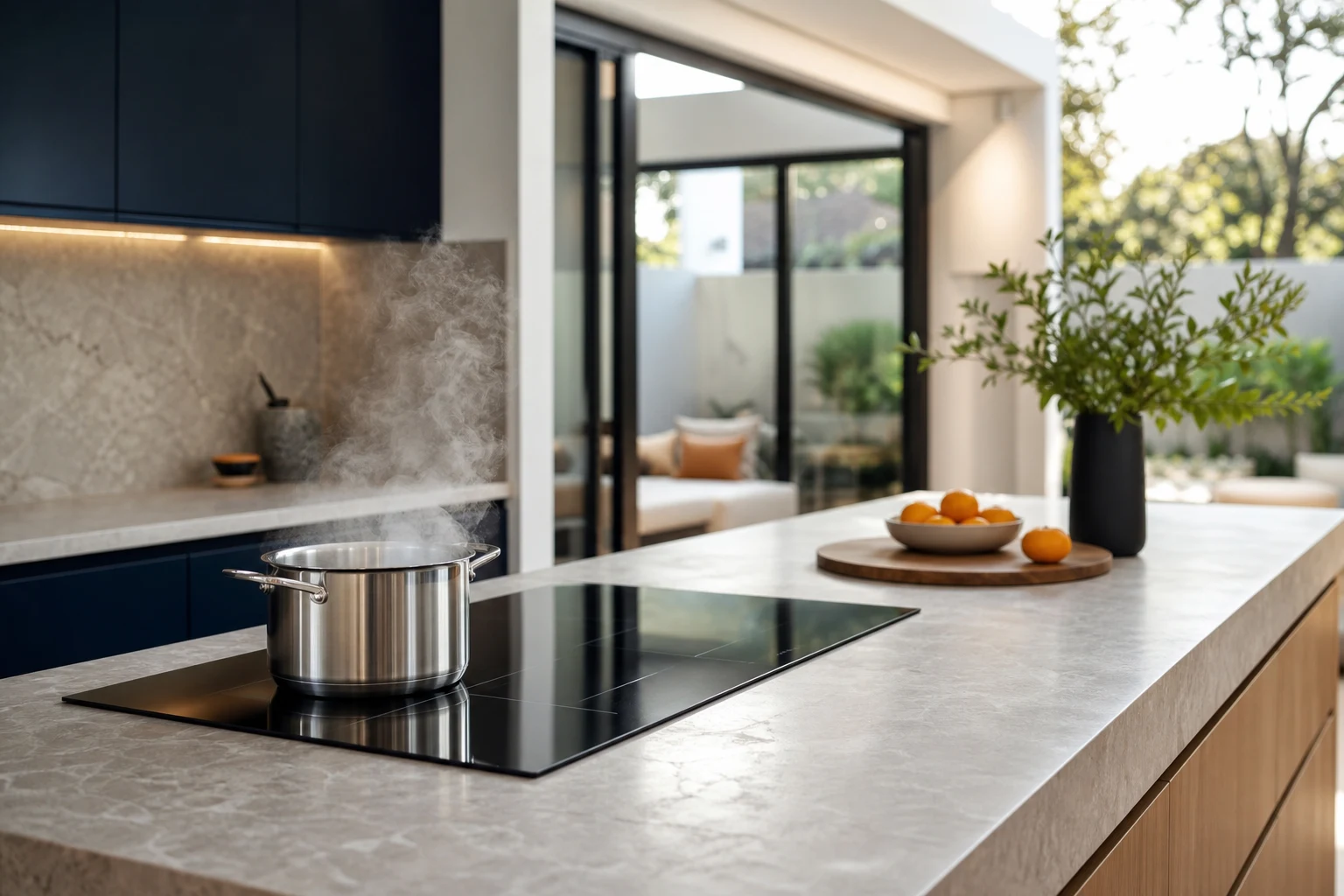
The cooktop decision used to be a matter of cooking preference. In Victoria it is now also a planning and infrastructure decision. State policy has been steadily moving new homes and, increasingly, major electrical and gas decisions away from residential gas connections, and many Melbourne homeowners renovating a kitchen are asking whether this is the moment to leave gas behind.
This guide compares induction and gas the way we assess them on real renovation projects: upfront and running costs, electrical capacity, ventilation and indoor air quality, cooking performance, and what the choice means for the rest of the renovation scope. The right answer depends on your home and your switchboard as much as your cooking style.
In this guide
The Victorian Context: Why This Decision Changed
Victoria has been progressively tightening the position of residential gas. New homes requiring a planning permit have been directed to all-electric for some time, and government policy has continued to push electrification for both cost and emissions reasons. Nothing currently forces an existing Melbourne home to disconnect gas during a kitchen renovation, but the direction of travel is clear.
- Renovating is the cheapest moment to switch: The electrician is already on site, walls are open and the benchtop cut-out is being made regardless.
- The gas supply charge is a whole-house question: If the cooktop is the last gas appliance after a ducted heating or hot water changeover, keeping it means paying a daily gas supply charge for one burner set.
- Future buyers are noticing: An induction-ready kitchen with modern electrical capacity reads as current rather than dated in a sale campaign.
We are not in the business of telling clients how to cook. We are in the business of making sure the decision is made deliberately, with the infrastructure costs on the table, rather than by default.
Side-by-Side Comparison
| Factor | Induction | Gas |
|---|---|---|
| Appliance price | Typically $700-$3,500 for quality 600-900mm units | Typically $400-$2,500 for comparable sizes |
| Installation needs | Dedicated circuit, commonly 32A; possible switchboard upgrade | Licensed gasfitter, gas line in position, compliance certificate |
| Heat response | Near-instant, precise low simmer control | Instant visual flame, coarser low-end control |
| Indoor air quality | No combustion by-products in the kitchen | Produces combustion by-products; good ventilation essential |
| Cleaning | Flat glass, wipe-down surface | Trivets, burner caps and spill trays to clean |
| Cookware | Requires magnetic-base pans; woks need flat bases or dedicated zones | Works with all cookware including round-base woks |
| Running cost direction | Efficient; improves further with rooftop solar | Exposed to gas prices plus daily supply charge |
On paper the comparison looks close. On real projects, the electrical scope and the whole-house gas question usually decide it.
The Electrical Reality of Induction
The most common induction surprise is not the cooktop price. It is the electrical work behind it, particularly in older Melbourne housing stock across suburbs with pre-1980s homes.
- Dedicated circuit: A full-size induction cooktop typically needs its own high-capacity circuit run back to the switchboard. Allow for the cable run distance in double-storey homes.
- Switchboard capacity: Older boards with ceramic fuses or limited spare poles often need upgrading, commonly $1,200-$3,000 depending on scope. If the board needs upgrading anyway for the renovation, the induction increment is small.
- Single-phase supply limits: Most Melbourne homes run single-phase power, which is usually adequate, but a home adding induction, an electric oven, air conditioning and a future EV charger deserves a load assessment.
This is why we scope the switchboard early on every kitchen project. Discovering the electrical constraint after the appliance order is how budgets get bruised.
What Gas Still Does Well, and What It Costs You
Gas retains genuine strengths: visual feedback from the flame, no cookware restrictions, round-base wok cooking, and continued operation during a power outage. Serious wok cooks in particular often hesitate to leave a high-output burner.
The offsetting costs are increasingly hard to ignore. A gas cooktop needs the gas connection maintained, which carries a daily supply charge regardless of usage. Combustion in the kitchen releases moisture and by-products that make effective ducted range hood extraction genuinely important rather than nice to have. And in a renovation where every other appliance is going electric, the single gas appliance carries the entire fixed cost of the connection.
- Keeping gas makes most sense when the home retains gas heating or hot water long-term and the cooktop position already has supply.
- Keeping gas makes least sense when it would be the last gas appliance in the house, or when the gas line would need extending to a new island or wall position anyway.
Cooking Performance: The Honest Assessment
Clients who switch to quality induction rarely go back, but the transition has a short learning curve worth being honest about.
- Speed: Induction boils water noticeably faster than gas and delivers heat with less waste into the room, which matters in a Melbourne summer.
- Control: Low-temperature precision, holding a sauce just below a simmer, is where induction clearly outperforms domestic gas burners.
- Cookware audit: Cast iron and most modern stainless cookware work fine. Older aluminium and copper pans without magnetic bases do not, so budget a modest cookware refresh into the project.
- Noise: Induction units produce a slight hum or fan noise at high power, which surprises some users but fades into the background quickly.
For households cooking daily, the wipe-flat cleaning surface alone tends to become the favourite feature within a month.
How the Choice Ripples Through the Renovation Scope
The cooktop decision touches more trades than any other kitchen appliance, which is why it should be locked early.
- Benchtop fabrication: Cut-out dimensions differ between models, so the stone or laminate fabricator needs the final specification before templating.
- Ventilation: Gas demands strong ducted extraction for air quality. Induction produces steam without combustion, so ventilation is still needed, but the stakes are lower.
- Gasfitting scope: Removing gas means the line should be properly capped or, if it is the last appliance, the whole connection reviewed. Extending gas to a relocated cooktop position adds licensed gasfitting cost.
- Underbench planning: Induction units are shallow, freeing drawer space below, but they need clearance and ventilation gaps per the manual, which affects drawer design.
A mid-renovation change from gas to induction, or the reverse, typically triggers variations across electrical, joinery and benchtop scope at once. Decide once, early, and hold the decision.
Our Recommendation Framework
When Melbourne clients ask us directly, the framework is simple. Choose induction if you are renovating for the next decade, your switchboard can support it or needs upgrading anyway, and you have or plan rooftop solar. Choose gas only if you have a strong cooking-style reason, the home is keeping gas for other appliances long-term, and the supply is already where the cooktop will sit.
The middle path some clients take is an induction cooktop with a plumbed gas point retained and capped nearby for a future decision. It is rarely used later, which itself says something about where the market has landed. Whatever the choice, make it before joinery drawings are approved, because the cooktop is the anchor around which the working side of the kitchen is designed.
Take these ideas with you.
- Victorian policy has shifted the cooktop question from pure preference to an infrastructure decision
- Induction usually requires a dedicated circuit and sometimes a switchboard upgrade in older Melbourne homes
- A gas cooktop that is the last gas appliance carries the full daily supply charge on its own
- Quality induction outperforms domestic gas on speed, low-heat control and cleaning
- Lock the cooktop model early because it affects electrical, benchtop, joinery and ventilation scope at once
A few more answers
Questions about your next step.
How much should I budget for a kitchen renovation in Melbourne?
Budget depends on layout changes, cabinetry level, benchtop choice, appliance scope and trade complexity. Fixed-layout refreshes sit much lower than structural redesigns with new services.
What kitchen upgrades usually add the most practical value?
Better drawer storage, smarter appliance placement, durable benchtops, layered task lighting and a well-sized rangehood tend to outperform cosmetic-only upgrades.
How long does a kitchen renovation usually take?
Most kitchens run over several weeks. Cabinetry manufacturing, stone templating and trade sequencing usually matter more than the demolition day.
Put your ideas into a plan
Check feasibility before you lock a quote
Council overlays, access and existing services change the job. Bring the property constraints in before finish selections harden.
We coordinate the electrical, gasfitting and joinery decisions so your cooktop choice is built in properly from the start. Explore our kitchen renovation service or call 1300 173 622 for practical advice on your home.