Melbourne winters are the real test of a bathroom. Cold mornings make heating non-negotiable for most households, and long stretches of cool, damp weather mean steam lingers unless extraction genuinely works. Yet ventilation is routinely the most under-specified part of a renovation: a cheap ceiling fan venting into the roof cavity, no makeup air, and mould on the ceiling within two winters.
This guide covers the parts that matter: how to size an exhaust fan properly, why ducting to outside air is the single most important detail, whether a 3-in-1 unit or separate systems suit your room, and what heating options actually cost. Get these right during the renovation, because retrofitting them later costs far more.
In this guide
- Why Extraction Is the Foundation of the Room
- Sizing the Fan: Airflow Numbers That Work
- Ducting to Outside: The Detail That Separates Good From Bad
- 3-in-1 Units vs Separate Systems
- Heating Options for Melbourne Winters
- Makeup Air, Switching and Compliance Details
- What Good Ventilation and Heating Costs in a Renovation
Why Extraction Is the Foundation of the Room
Every shower puts a large volume of water vapour into the air. If that moisture is not removed quickly, it condenses on the coldest surfaces in the room, which in a Melbourne winter means windows, external walls and the ceiling. Persistent condensation feeds mould, lifts paint, corrodes fittings and shortens the life of everything you just paid for.
Extraction protects more than the bathroom. Moist air that escapes into hallways and bedrooms raises humidity through the house, and moisture pushed into the roof cavity by a non-ducted fan condenses on the underside of roofing and framing. We have opened plenty of ceilings in older Melbourne homes where years of roof-space venting left timber stained and insulation damp.
- The goal: Clear visible steam within roughly ten minutes of a shower ending.
- The method: A correctly sized fan, ducted to outside, with a path for replacement air to enter the room.
Sizing the Fan: Airflow Numbers That Work
Fans are rated by airflow, usually in litres per second or cubic metres per hour. The working rule for bathrooms is to achieve numerous full air changes per hour, and in practice most standard Melbourne bathrooms land well with a fan delivering a genuine 25 to 50 litres per second at the grille, not just on the box.
- Small bathroom or powder room: Around 25 L/s is typically adequate.
- Standard family bathroom: 35-50 L/s covers most rooms with a shower.
- Large bathrooms, open showers or steam-heavy households: 50 L/s and up, or two extraction points.
Two details are routinely missed. First, rated airflow assumes minimal duct resistance; long duct runs, tight bends and cheap flexible ducting can cut real-world performance dramatically, so oversizing modestly is sensible. Second, fan placement matters: the fan should sit close to the shower, where the steam is, rather than in the centre of the room by default. A quiet fan is also a fan that gets used, so check the sone or decibel rating before buying.
Ducting to Outside: The Detail That Separates Good From Bad
The National Construction Code requires exhaust from bathrooms to discharge to outdoor air in most circumstances, not into the roof space. Despite this, venting into the roof cavity remains one of the most common defects we find in existing Melbourne homes, usually because it was the cheapest path on the day.
- Roof cowl or eave vent: Duct runs from the fan to a dedicated roof penetration or vented eave outlet. This is the correct termination.
- Rigid or semi-rigid duct: Smooth-bore duct moves air far better than crushed flexible duct snaked around roof timbers.
- Short, direct runs: Every metre and every bend costs airflow. Plan the fan position with the duct route in mind.
- Backdraft damper: Stops cold outside air dropping back into the bathroom in winter.
During a renovation, the ceiling is open and the roof is accessible, so proper ducting adds modest cost. As a retrofit through a finished ceiling it becomes a much bigger job, which is exactly why it gets skipped. Insist on seeing where your duct terminates before the ceiling closes.
3-in-1 Units vs Separate Systems
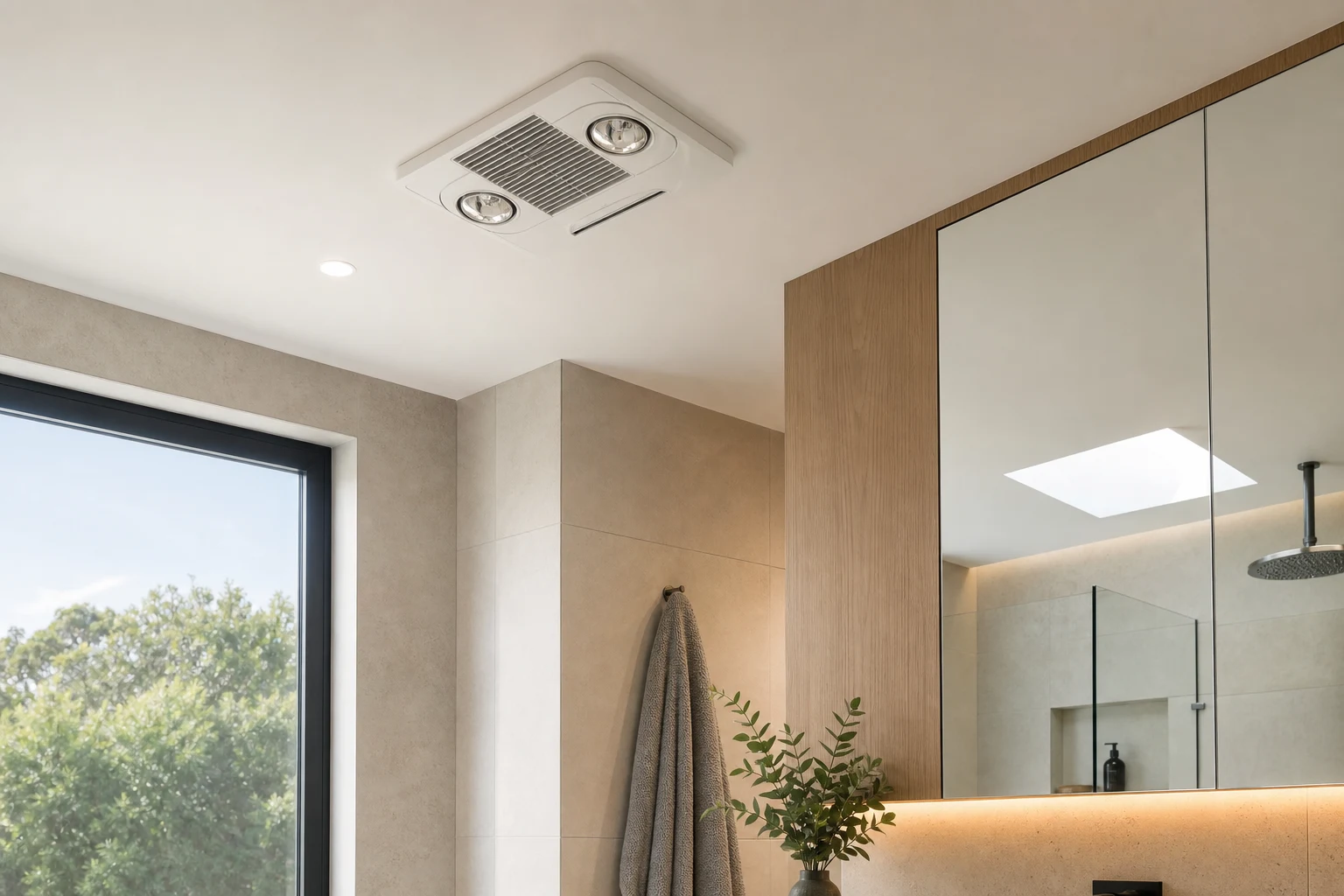
The ceiling-mounted 3-in-1 unit, combining heat lamps, a fan and a light, has been the Australian default for decades. It is compact and cheap, but it involves compromises worth understanding before you default to it.
| Option | Typical Installed Cost | Strengths | Weaknesses |
|---|---|---|---|
| 3-in-1 heat lamp unit | $400-$900 | One ceiling penetration, instant radiant warmth, low entry cost | Extraction is usually the weakest of the three functions; heat only under the lamps |
| Separate inline fan + panel heater | $900-$1,800 | Strong, quiet extraction; even background warmth; each component sized properly | More wiring and wall space required |
| Separate fan + electric underfloor heating | $1,600-$3,500 | Warm floor comfort, dries the floor, invisible in the room | Highest install cost; must be laid before tiling, impossible to retrofit |
Our general position: in a full renovation, separate systems deliver a noticeably better result because each component is chosen for its job. The 3-in-1 remains a fair choice for budget-focused projects and rental properties, provided it is actually ducted to outside.
Heating Options for Melbourne Winters
Bathroom heating in Melbourne is about the first two minutes: stepping out of the shower on a five-degree morning. Different systems solve that moment differently.
- Radiant heat lamps: Instant warmth directly under the unit. Cheap to install, inefficient to run for long periods, and warmth is localised.
- Wall panel or strip heaters: Even room warmth on a timer, good for rooms used by children or older family members who take longer.
- Electric underfloor heating: The comfort benchmark. Commonly $500-$1,200 in materials for a typical bathroom plus electrical connection and a programmable thermostat, laid under the tiles during the renovation. Run on a morning timer, it also helps dry the floor and control moisture.
- Heated towel rails: Not a room heater, but they keep towels dry between uses, which matters in a cool, damp climate where towels otherwise stay damp all week.
Hydronic underfloor systems exist but rarely stack up for a single bathroom unless the home already runs hydronic heating; electric mats are the practical renovation choice.
Makeup Air, Switching and Compliance Details
A fan can only push air out if replacement air can get in. A tightly sealed bathroom with no air path will strangle even a powerful fan. The standard solution is a 10mm to 20mm undercut on the bathroom door or a door grille, and it costs almost nothing during a renovation.
- Run-on timers: A fan that runs 10-15 minutes after the light switches off clears residual steam properly. Humidity-sensing fans automate this entirely and suit households that forget.
- Electrical zones: Wet areas have defined electrical safety zones that restrict where switches, heaters and some fittings can be installed. This is licensed-electrician territory, and your builder should be coordinating it, with a certificate of electrical safety issued for the work.
- Window ventilation: An openable window helps but does not replace mechanical extraction in a renovation done to current expectations, and in July nobody opens it anyway.
What Good Ventilation and Heating Costs in a Renovation
Within a full bathroom renovation, the ventilation and heating package is a small share of total spend but delivers outsized daily value. A quality ducted extraction setup typically adds $600-$1,400 including the fan, rigid ducting, roof termination and electrical work. Adding a panel heater or heat lamp sits in the hundreds; underfloor heating adds $1,600-$3,500 installed depending on room size and thermostat choice.
Compare that with the cost of not doing it: mould remediation, repainting ceilings every few years, regrouting, and in bad cases replacing water-damaged plaster or roof insulation. On a $25k-$35k renovation, skimping on the least glamorous $1,500 in the room is the falsest economy available. Specify the fan model, duct type and termination point in your quote so you can verify what you are actually getting.
Take these ideas with you.
- Bathroom exhaust must duct to outside air, not the roof cavity, and this is the most common defect in existing Melbourne homes
- Size fans for the real room and duct run, aiming for roughly 25-50 litres per second depending on bathroom size
- Separate extraction and heating systems outperform 3-in-1 units, which trade performance for a low entry price
- Electric underfloor heating must go in before tiling, so the decision has to be made early, not at fit-off
- A door undercut and a run-on timer cost almost nothing and dramatically improve how well extraction works
A few more answers
Questions about your next step.
What matters most in a small bathroom layout?
Clearances, door swing, shower placement and vanity depth matter more than decorative choices. Simplify the layout before adding premium finishes.
Which bathroom materials are easiest to maintain?
Low-porosity surfaces, practical grout, well-detailed shower screens and real ventilation reduce cleaning load and mould risk.
How long does a full bathroom renovation normally take?
Bathrooms are tightly sequenced, but waterproofing cure times, tiling and fixture lead times still make them multi-stage projects.
Put your ideas into a plan
Turn this cost guide into a real number
A useful quote names layout, services, finish level and exclusions. We measure in the house, then price the room you actually have.
Renovating and want a bathroom that stays warm, dry and mould-free through a Melbourne winter? We specify ventilation and heating properly on every project. Learn about our bathroom renovations.